
Readers of The Long Walk have already met this man. I introduced him a few weeks ago as Dave.
Dave has been there eleven years. Dave knows why the release process has that one strange step, which client will escalate to the board if you miss a Thursday, and which of the three environments named "staging" is the real one. Dave is generous with all of it. Ask Dave anything and Dave will tell you, at length, happily. Dave is also the entire map, and when Dave takes two weeks in July the organization experiences something that feels a great deal like a power cut.
I thought I had said everything there was to say about Dave. I was wrong. Dave has a second map now. This one is for the machine, and nobody else has seen it either.
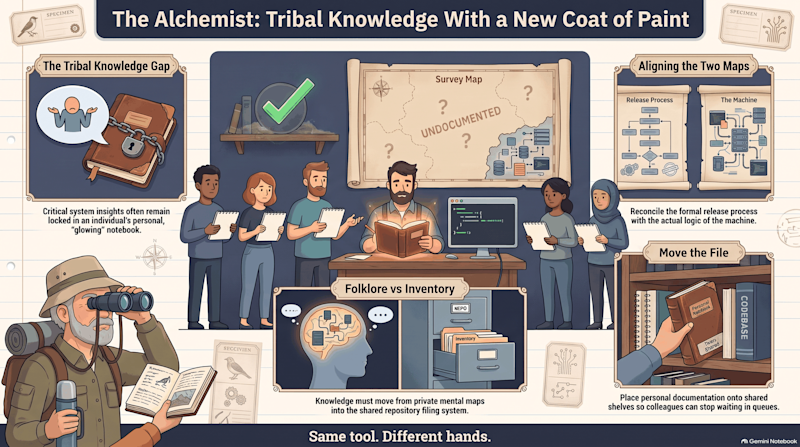
Field notes
Habitat: a personal notes file, four thousand words long, last modified this morning. Sometimes a second file, for "the other one."
Call: "It is just the way I talk to it." Delivered with a shrug that is not quite modesty.
Diet: context, in quantities nobody else thinks to provide.
Field marks: genuinely excellent results. A queue of colleagues at his desk. A visible wince when the next desk types a one line prompt and pastes whatever comes back.
Not to be confused with: the Hostage Negotiator (Part 2), who also writes a great deal to the machine but has not noticed that what he is writing is a spec.
Observation
I watched the Alchemist for most of a week, longer than any other species, because he is the hardest to see. There is no lever. There is no arguing. He types for a while, mostly before he asks for anything, and then the machine produces something that is, and I want to be precise here, good. Not compiling. Not passing. Good. Named the way the codebase is named, structured the way the team would have structured it, with the one edge case the ticket forgot handled and a comment explaining why.
I asked him how. He opened a file. It was long. It had sections. It knew things about the system I would have expected to find in an architecture document, if the organization had one, which it did not. It had a list of things the machine gets wrong in this codebase and what to say to stop it. It had, near the top, a line that said do not trust a green check until you have read what it checked, which is the sentence I spent all of Part 1 trying to write.
Then he closed the file. I asked whether the team had a copy. He said, kindly, that it would not really work for them, because it was just the way he talks to it.
Tribal knowledge does not go away when you add a machine. It gets a second volume, and the machine cannot read the first one either.
A second confession
Before I describe the animal I should admit, as I did in Part 1, that I am looking at a relative.
I have the file. I have had it for about a year. It is closer to six thousand words than four, and it knows things about how I want a problem approached that I have never said out loud to a colleague.
I have never shared it. Not out of secrecy. Out of the same vague sense that it would not really work for anyone else, that it is the way I talk to it. Which is, I now realize, exactly what Dave says about the release process.
What the Alchemist actually is
Strip the mystique off and here is the animal.
The Alchemist has discovered the true thing about the machine, the thing the Slot Machine and the Notary never will: it is only as good as the context you hand it. It knows nothing about your system except what is in front of it in the moment. Everything it is missing, he supplies, in writing, before he asks. That is the whole trick, and it is not a trick. It is craft.
He has then stored that craft in the one place the organization cannot reach. His own head, with a backup on his own laptop.
This is tribal knowledge with a new coat of paint. It is Dave, eleven years in, except now Dave is also the entire map for AI, a map nobody else surveyed, and the organization does not know it exists because it only sees the output. The output is excellent. So nobody asks.
Why it feels like it works
It works because it does work, and I do not want to soften that.
Every organization I have watched roll out the tool has one or two of these people, and their results are the best argument the tool has. When the leadership deck says the machine is transforming delivery, the slide is built from the Alchemist's pull requests. His code is the evidence. His method is not, so the organization concludes that the tool is good, rather than that the tool is good in his hands, and goes and buys more seats for the Slot Machines.
From his side of the desk, keeping the file private is not selfishness. He has watched a colleague borrow a paragraph, paste it in front of a lazy prompt, and get lazy results, and concluded that the file does not transfer. He is right, as far as it goes. What he has missed is that the judgment behind the paragraph could be written down too, and nobody else has done so because he is the only one who knows it needs writing.
The delivery truth
In Building on Solid Ground I spent an essay on the machine's nature, and one sentence matters here more than the rest: it remembers nothing on its own. Every conversation starts from zero unless you hand it the context. That is why the shared record, the one source of truth where every claim carries its origin, is a foundation and not a nicety. It is how the intern stops being an amnesiac.
The Alchemist has built that record. He has built it beautifully. He has built it for one.
So the machine on his desk is not an amnesiac, and the machine on every other desk still is. The organization has, without noticing, made one person the memory of its AI. That is the single point of failure I warned about, except worse, because this one can be interrogated, would answer happily and at length, and is going to leave.
When Dave leaves, the map leaves. When the Alchemist leaves, the machine forgets how to work here.
The delivery risk is the one The Long Walk described, in new clothes. Folklore is knowledge the organization never wrote down. Inventory is knowledge it did. A four thousand word file on a personal laptop, however good, is folklore: nobody can find it, nobody can review it, nobody knows when it changed or why, and nobody would notice if it walked out the door on a Friday.
What he gets right
The Alchemist gets more right than any species in the guide, and I would rather have one of him than five of anyone else.
He has the correct model of the machine. Not magic, not possessed. A brilliant, tireless, amnesiac drafter that is exactly as good as its briefing. He behaves accordingly, which puts him ahead of most of the vendors.
He treats prompting as a craft. He does not iterate on the output. He iterates on the approach: every time the machine gets something wrong in a way that could have been prevented, a line goes in the file. He is running a continuous retrospective on his own instructions, and they are getting better. It is the most grown-up relationship with the tool I have seen anywhere.
He does not trust the Green Check. It is in his file, near the top. He reads what he ships, which is more than the Ghost will be able to say in Part 6, and it is why his excellent output is also safe output.
He supplies what the ticket left out. The edge case, the convention, the reason. Half of what looks like the machine being clever is the Alchemist being thorough before he asked.
His results justify the investment. The time he spends before asking is repaid, visibly, on every piece of work that follows, which is the only honest way to judge any craft.
He is the closest thing in the field guide to the animal we are building toward in Part 7. His only defect is that he is a library with one card, and the card is in his wallet.
The Alchemist is not hoarding. He is simply the only person who knows there is something to share.
The fix is not to stop him
The wrong reading of this post is "make the Alchemist stop being special," and organizations are very good at that particular kind of harm.
The fix is to move the craft out of the notes file and into the shared record, the way Solid Ground said every piece of knowledge should be stored: distilled rather than dumped, with its origin attached, in a place the organization owns. The master prompt goes into the repository, next to the code it describes. It gets a history, so you can see which incident added which line. It gets a reviewer, so the second Alchemist can argue with the first. It gets a name on it that is not only his.
He will tell you it will not work for anyone else. Try it anyway. About two thirds of the file is not personal at all. It is architecture, conventions, and hard-won knowledge about what the machine gets wrong here, and that part transfers perfectly, because it was never about him. It was about the system. The remaining third, the way he likes a problem approached, can stay his. That is taste, and taste is allowed.
What you get is the organization's briefing for the machine, owned by the organization, improving every time anyone learns something, surviving every departure. The Alchemist loses nothing. He gains colleagues who can hold up their end.
The habit the Crew Chief keeps
One line to carry out of the blind, for the finale.
Context is the craft, and craft belongs in the shared record. The machine is exactly as good as its briefing, so the briefing is engineering work, and engineering work goes in the repo, with a history, a reviewer, and more than one name on it. The best briefer is not the problem. The notes file is.
Before you go, find your library
You could name him before you finished the field notes. The person on your team whose generated code is visibly, reliably better than everyone else's.
Now ask one question, honestly: if he were out for a month, could anyone reproduce it? Not his output. His method. Could a competent colleague sit at his desk, with his tools, and get his results?
If the answer is yes, you have a shared record and I would like to know where you work. If the answer is a pause, and then "well, he has a file," you have Dave with a second map, and the clock from The Long Walk is running on this one too.
Whether the craft of using the machine lives in a structure or in a person is one of the things GSD's Maturity Assessment looks for directly, because the slide always says the team has adopted AI and the floor frequently means one man and a text file. Find out which you have. Then move the file, before he does.
For now, go and ask the Alchemist if you can read the file. He will say yes. He always does. Then put it somewhere the building can find it.
Same tool. Different hands.
Next in the series, Part 5: "The Holdout: Right About Everything Except the Conclusion."
*Is your team's AI craft in a shared record or in one person's notes file? GSD's Maturity Assessment is the entry point, a structured look at how the machine is actually used on your floor, before you invest in fixing the wrong thing.*
Back to Blog