
Every field guide has one entry the author would rather not have written. The animal you never see alive, only by what it leaves behind.
This is that entry. You will not spot the sixth species at his desk, because at his desk he looks like the best engineer you have. You spot him at two in the morning, by his absence, in a room full of people staring at code that nobody recognizes.
Field notes
Habitat: the top of every contribution graph, and nowhere at all during an incident.
Call: none. He does not argue with the machine, negotiate with it, or reroll it. He accepts. Silence, then a merge.
Diet: whole features, swallowed without chewing. Sometimes whole services.
Field marks: enormous volume. A commit history that reads as fluent and confident. A blank, pleasant expression when asked what any of it does.
Not to be confused with: the Slot Machine (Part 1), who at least knows which attempt he shipped.
Observation
I was not in the blind for this one. I was on the incident bridge, muted, with the thermos, which is where a naturalist ends up when the species in question is nocturnal.
The pager had gone off at 2:04am. A billing reconciliation job was double-charging a subset of accounts. Not all of them, which would have been easier, because a job that charges everyone twice gets turned off in four minutes. This one charged about six percent of accounts twice, on a pattern nobody could name, and it had been doing so for eleven days.
The on-call engineer had the job open and was reading it aloud, slowly, the way you read a contract in a language you studied for one semester. He did not know what it did. The team lead joined at 2:20 and did not know either, and she had approved the pull request, which she mentioned in a voice I will not forget. Somebody paged the author.
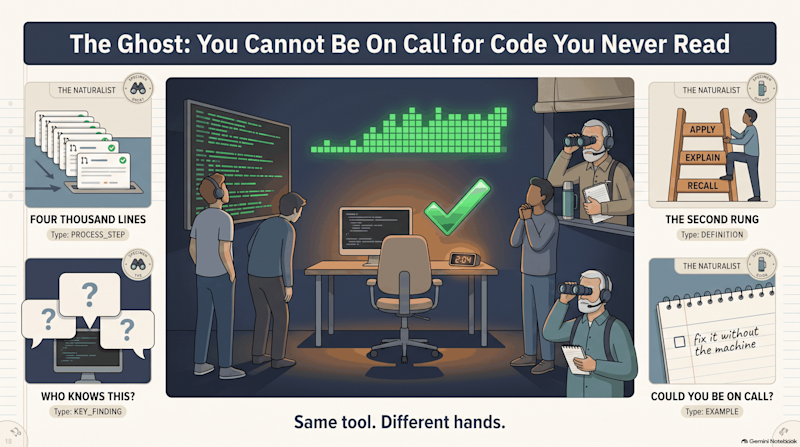
The author answered at 2:51. He had written the job in March. That week he had shipped a little over four thousand lines across three services, all of them green, all of them merged, all of them praised in the retro as an example of what the tool makes possible. Somebody put the reconciliation loop on the screen and asked him why the ledger cursor advanced before the write was confirmed.
He read it for a long moment. Then he said the sentence this entire post is about.
"I think it's supposed to handle the retry."
He did not know. He had never known. The code had passed through him the way weather passes through a valley, leaving nothing behind but a commit with his name on it. And the customer was a bank, and the bank had lawyers, and by nine that morning the lawyers had a question the company could not answer: who understands this system?
A commit with your name on it is a promise that you can explain it. The Ghost signs the promise and never reads the terms.
What the Ghost actually is
Strip the eeriness off and here is the animal.
The Ghost ships code he does not understand, at volume, on purpose, and the volume is the point. He is not lazy. Lazy people do not top the contribution graph. He has simply reorganized his job around a single activity, accepting what the machine produces, and removed every step that would slow that activity down, including the step where he learns what he just accepted.
He is what the Slot Machine grows into when nobody stops him. The Slot Machine at least argues with the exit code; the Ghost does not need to, because the machine has gotten good enough that the first pull is usually green. And he is what the Notary makes possible, because every one of those four thousand lines went through a review that had never once said no. Remove the friction on both sides and this is the creature that walks through.
The result is a codebase that reads as confident and fluent, because the machine writes confident, fluent code, and that is owned by nobody. Not the reviewer, who did not read it. Not the author, who did not either. The question "who knows this?" had no answer on the day it was merged. Nobody had asked yet.
Why it feels like it works
Here is the uncomfortable part, and it is more uncomfortable than the Slot Machine's version.
It works for months. Sometimes for a year.
The Ghost is a hero for most of that time, and not a fake one. Features land. Backlogs shrink. Delivery commitments that used to slip get demoed on schedule. The people managing him see the graph and see a person who has evidently figured out what everyone else is struggling with. He gets the retro shout-out. He gets the raise.
And the code is fine, mostly, because the machine is good and most code is not the reconciliation loop. The bill does not come due on the median line. It comes due on the one line in four thousand that mattered, and that line looks exactly like the others, and nobody knows which one it is until the pager finds it for them.
Understanding debt is the only kind of debt that charges its interest to whoever is holding the pager.
The delivery truth
You cannot be on call for code you never read.
I wrote in The Bill Comes Due that AI cost has three faces: the machine, the infrastructure, and the humans who have to check what the machine produced. The Slot Machine, in Part 1, moved the human cost to the end and declined to pay it. The Ghost has done something more sophisticated. He has taken out a loan against it. Every line merged without comprehension is borrowed understanding, and the terms are simple: you pay nothing now, and you pay everything at once, at two in the morning, when the incident finally names the line.
That is what makes understanding debt different from the ordinary technical kind. Ordinary technical debt sits in the code where anyone can read it and groan. Understanding debt sits in the gap between the code and the people, and it is invisible, because the code looks good. It compounds quietly. Every feature shipped on a foundation nobody understands adds a floor to a building nobody can inspect, and the day the ground floor fails, the whole thing has to be understood at once, from scratch, by whoever is awake.
So here is the plain version. If nobody in the building can be on call for it, you did not ship a feature. You shipped a liability with a green check on it. The check told you the tests passed. It never told you anyone could fix it when the tests turned out to be wrong.
In The Long Walk I borrowed a ladder from educators, Bloom's rungs of behavior, for describing what a person can actually do: recall, explain, apply, and so on upward. Every level of every job we wrote acceptance criteria for started on the second rung, because explaining a thing is the floor of competence, not the ceiling. The Ghost cannot reach the second rung about his own code. He can recall that he wrote it. He cannot explain it. And an organization that promotes him is writing the word "Senior" on a résumé it cannot read.
I also said, in Know Thy Machine, that the system of record owns the lifecycle and the machine only owns the thinking inside one step, so that the long story of a piece of work lives somewhere durable instead of in the head of a model that forgets when the session ends. The Ghost has found the loophole. The story lives nowhere. Not in the machine, which forgot it in March. Not in the author, who never had it. The building has permanent records of a decision nobody made.
One more thing, said lightly because I have said it at length before. The person who leaves after that 2am is usually not the Ghost. It is the on-call engineer who spent five hours reading someone else's unread code with a bank on the line, and who has now learned what the shop actually rewards. I wrote about that departure once. It looks the same from here.
What he gets right
I promised this series would not be six posts of contempt, and the Ghost has the hardest case to make, so let me make it properly.
He finishes things.
Do not underestimate how rare that is. Half the Holdouts in the world, morally correct and hand crafting, would give a great deal for the Ghost's appetite to ship. He does not polish a pull request for a week. He does not get stuck at the ninety percent mark where careful engineers go to admire their own work. He wants it in production, and he gets it there, and there is a version of that appetite that is the single most valuable trait in a delivery organization.
The appetite is not the defect. The appetite unsized is the defect. He is shipping more than he can stand behind, and the fix is not to ship less on principle. It is to size the appetite to what a person can actually be on call for.
The habit the Crew Chief keeps
So here is the one line to carry out of the blind, and it is the bluntest one in the series.
Ship only what you could be on call for. Before you merge, one question, asked honestly with the assistant pane closed: if this pages at 2am, could I fix it without the machine? If the answer is yes, ship it, and ship it fast, because you are the Ghost with the appetite and none of the debt. If the answer is no, the change is not done, however green it is. Read it until the answer is yes, or make it small enough that it can be.
That is the whole conversion. The volume stays. The understanding catches up to it.
Before you go, close the assistant pane
You already know whether this is your shop. You do not need me for the diagnosis, and you do not want to find out the way the bank did.
Pick a generated change from last quarter that is in production. Not a big one, an ordinary one. Find its author. Ask them to walk you through it with the assistant closed. Then start a clock and time how long it takes to reach the words "I think."
A confident walk-through, good. A pause, and then the tab opening so they can ask the machine what they wrote, and you have a Ghost. The question is not whether the pager goes off. It is which line, and which night.
Whether anyone in your building could be on call for what the machine has shipped, as opposed to whether it shipped, is one of the sharper things GSD's Maturity Assessment goes looking for, because a contribution graph is the easiest thing in the world to admire and the hardest thing in the world to interrogate at two in the morning. Find out which you have. Then fix it, in that order.
That is the field guide. Six species, one tool. Next week, the animal you actually want, assembled from the one thing each of them got right.
For now, go find your busiest engineer and ask about the third file in their last merge. Then ask if they would take the pager for it tonight.
Same tool. Different hands.
Next in the series, Part 7: "The Crew Chief: The Hands You Actually Want."
*Could your team be on call for what the machine shipped? GSD's Maturity Assessment is the entry point, a structured look at how the machine is actually used on your floor, before the pager finds out for you.*
Back to Blog