
Of the six species in this guide, the Notary is the one your compliance team would like least, if your compliance team ever found out he existed. They will not, because he is the reason the binder looks perfect.
He is also the hardest to spot, because everything about him looks like the process working. There is a reviewer on every pull request. There is a name and a timestamp on every approval. The dashboard that reports the percentage of changes reviewed before merge reads one hundred, and has for a year. If you are the kind of leader who reads dashboards, you would put this team on a slide.
Bring the binoculars.
Field notes
Habitat: the top of the reviewer list. Always available. Never blocking.
Call: "LGTM," at a cadence no human reading could sustain. Occasionally "nice" or a thumbs up, when he is feeling thorough.
Diet: pull requests, whole, without chewing.
Field marks: an approval rate of one hundred percent. A median review time under ninety seconds. A reputation, universally held and warmly meant, as "easy to work with."
Not to be confused with: the Ghost (Part 6), who at least wrote the code he does not understand.
Observation
I timed him. This is not a figure of speech. I sat in the blind with a stopwatch and the notifications feed, because I had a suspicion, and a naturalist who does not measure is just a man with opinions and a thermos.
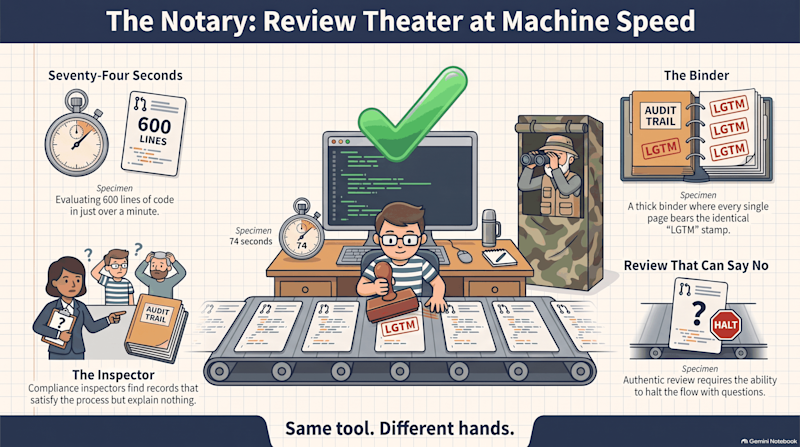
Eleven pull requests in one afternoon, all of them mostly generated, all of them routed to him because he was the reviewer who never held anyone up. Average size: a little over six hundred lines changed. Average time from the pull request opening to his approval landing: seventy-four seconds.
Seventy-four seconds. For six hundred lines. I have taken longer to read a menu.
Every one of the eleven was approved. No comments, no questions, no request for a test, no "what does this block do." Eleven green checks in an afternoon, each one carrying his name, each one now part of the permanent record of how that code got into production.
And then the sentence that turns this from a joke into the reason I am writing it. When I asked him, later and gently, when he had last sent a generated change back, he thought about it honestly and could not remember doing so. Not once. Not since the tool arrived. Not because the code had always been right. Because sending it back was never the job he understood himself to have.
A review with a zero rejection rate is not a review. It is a signature with a delay.
What the Notary actually is
Strip the joke off and here is the animal.
The Notary has confused the ceremony of review with the function of review. The function is to catch what the author missed and stop it before it ships. The ceremony is a second name on the record. He performs the ceremony flawlessly and at extraordinary speed, and he has never once performed the function, because the function requires reading, and reading six hundred lines takes longer than seventy-four seconds no matter who you are.
What he actually does, if you watch closely, is check the shape. Is the check green? Does the title match the ticket? Does the diff look like code? Three glances, one click. He is a notary public: he certifies that a signature happened in his presence. He has no opinion, and was never asked for one, about what the document says.
The tool made this species possible, and it is worth understanding why. Before the machine, an author who wrote six hundred lines had at least read them once, on the way in. Review was the second reader. Now the author is frequently the Slot Machine from Part 1, who read the exit code and nothing else, which means the reviewer is the first human reader of the change, and the Notary has declined the position. Nobody has read it. The Green Check has read it, and the Green Check, as established, is the most trusted liar in the building.
Why it feels like it works
Here is the uncomfortable part, and as always I will say it plainly so you believe the rest.
It feels like it works because nothing visible breaks, and the things that break are not attributed to him.
He is fast, so the team is fast. He is agreeable, so the team likes him. The dashboards are perfect, so leadership likes the team. When a generated change eventually fails in production, and it does, the incident review looks at the author and at the tests and at the runbook, and it does not look at the review, because the review has a name and a timestamp on it and that is what a review is supposed to have. The control appears to have operated. The control did not operate. There is no line item for the difference.
Meanwhile every engineer on the team has quietly learned which reviewer to route to when they are in a hurry, and in a shop running on the tool, everyone is always in a hurry. The Notary is not just tolerated. He is selected for. He is the path of least resistance, and the pull requests flow downhill to him like water.
The delivery truth
Review theater is worse than no review, and I want to be careful here, because this is the sentence people push back on.
No review is at least honest about the risk. Everyone knows the code went in unread, and the organization can decide whether that is acceptable and act on it. Theater does something worse. It manufactures a record, with a name and a timestamp, that says a competent human examined this change and found it acceptable. And the record is false. Not incomplete. False.
I have been here before, in a previous life, when I wrote about the Audit Flywheel and the organizations where compliance had become the product. The cruelest thing about that flywheel was compliance theater: policies that existed but were not followed, manual controls that got skipped under pressure, evidence assembled at the last minute by people who all knew it was theater and none of whom said so. The Notary is that same disease with a merge button. The control exists on paper, exactly as the policy requires. It fails in reality, eleven times an afternoon. The only difference is that he fabricates the evidence in real time instead of two weeks before the audit, which is more efficient and therefore worse.
And in The Inspector at the Door I argued that a trail with the embarrassing parts erased is not a trail, it is an alibi. A trail that never once said no is the same thing wearing a nicer suit. When the inspector comes, and the inspector always comes, whether it is Risk, the regulator, the customer's security team, or the incident at two in the morning, the question will be simple. Who approved this change, and on what basis? The honest answer is: a person who did not read it, on the basis that the check was green. That is not a gap in the process you can remediate with a finding. That is evidence against the process, in your own handwriting, dated.
An approval that was never capable of being a rejection is not a control. It is a confession you have not been asked for yet.
If you are in a regulated industry, and I am thinking of a few of you specifically, sit with that for a moment. Your change management control almost certainly says that a qualified second person reviews every production change. Your evidence for that control is the approval record. And your approval record, if you have a Notary, is a stack of seventy-four-second certifications of six-hundred-line generated diffs. You have not met the control. You have documented, meticulously, that you did not.
I said in Know Thy Machine that an agent that can approve its own work is not an employee, it is an accident with a résumé. A human who approves everything the machine produces is the same accident with a better résumé, and a badge that gets him past the auditor.
What he gets right
I promised this series would not be six posts of contempt, and the Notary genuinely earns his paragraph.
The step always happens. Nothing on his team goes to the main branch without passing through a review, and that is more than half the shops I have walked through can honestly say. He is never the bottleneck. He is never the reason a delivery commitment slips. He shows up, every time, for every change, and the habit of always routing work through a second person is real and valuable and took someone effort to install.
The habit is intact. It is only missing the capacity to say no.
The habit the Crew Chief keeps
So here is the one line to carry out of the blind, the third of six.
Review that can send things back. A review is only a control if rejection is a live possibility, and the way to know whether it is live is to count it. Do not put approvals per day on the wall. Put up the fraction of generated changes that came back with a question. If that number is zero, you do not have a review step. You have a notary, and you should at least stop paying him a reviewer's wage.
One practical addition, because "read more carefully" is not advice. Make the reviewer write one sentence about what the change does before they see the author's description. If they cannot, they have not read it, and the pull request is not ready for their name.
Before you go, pull two numbers
You already know whether this is your shop. The difference from the earlier posts is that this time you can prove it in ten minutes, and I would ask you to, because the stakes are your audit trail rather than one bad afternoon.
Go to whatever tool holds your pull requests and pull two numbers for generated changes over the last quarter: the approval rate, and the median time from open to approve. If the first is one hundred percent and the second is under two minutes, you have a Notary. It does not matter how good the engineer is or how well liked. You have an approval record that certifies reading that did not happen, and the next person to notice may not be you.
Whether your review step is a control or a costume is one of the sharper things GSD's Maturity Assessment goes looking for, precisely because the dashboard cannot tell the difference and the inspector eventually can. Find out which you have before someone else does. Then fix it, in that order.
Next week, the species you would most like to hire: the one who has genuinely mastered the machine, gets results nobody else can match, and keeps the whole method in a personal notes file that leaves the building when he does.
For now, just go and find the last time a generated change on your team was sent back with a question. If you have to scroll past the arrival of the tool to find it, you have your answer.
Same tool. Different hands.
Next in the series, Part 4: "The Alchemist: Tribal Knowledge With a New Coat of Paint."
*Is your review step a control or a costume? GSD's Maturity Assessment is the entry point, a structured look at how the machine is actually governed on your floor, before the inspector asks who approved what.*
Back to Blog