
I once sat through a hiring debrief that ran fifty minutes and produced the word "smart" nineteen times.
Four interviewers. Four enthusiastic recommendations. Everyone agreed the candidate was smart, sharp, strong, a good communicator, and a culture fit. We made the offer that afternoon and felt like a very efficient organization.
Nine months later that hire was gone, and the exit was nobody's fault in the way that these things are always nobody's fault. He was, in fact, smart. He was also a builder of systems dropped into a job that was ninety percent negotiating scope with irritable stakeholders, and not one of the four of us had said that out loud, because not one of us had written down what the job was.
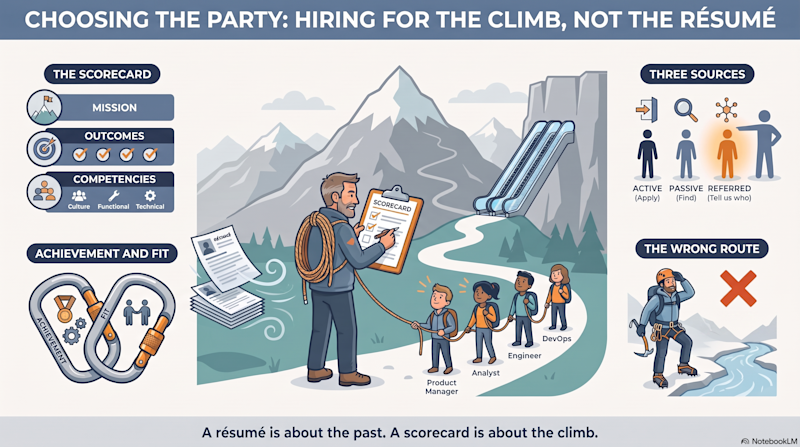
We had not hired badly. We had roped a talented ice climber onto a river crossing.
A résumé is a marketing document about somebody's past. A scorecard is a contract about their future. Only one of those tells you whether they can do the climb.
The question you are actually asking
Strip away the ceremony and every hiring process is trying to answer exactly one question: can this person succeed here?
Not "is this person impressive." Impressive is easy to detect and nearly worthless on its own, because impressive is a property of the person and success is a property of the person and the route. The same climber who is magnificent on rock is a liability on ice. The industry has spent decades optimizing for the detection of impressive, and then acting surprised when impressive people leave in nine months.
The question breaks into two halves, and I want both of them named because organizations habitually run on one and pretend they ran on both.
Achievement. Can they produce the outcomes the role exists to produce? Not "do they know the technology." Have they, in the actual world, delivered the kind of result you need delivered?
Fit. Will they succeed in this party, on this route, with these people and this way of working? Fit is not "would I have a beer with them," which is the most expensive sentence in hiring and has done more to entrench homogeneity than any policy ever written. Fit is whether the way the person works and the way the team works can survive contact with each other.
Achievement without fit produces the brilliant hire who detonates the team. Fit without achievement produces a delightful colleague who cannot do the job. You need both, on purpose, and you need to know which one you are testing at any given moment.
Write the job down before you meet anybody
Here is the discipline, and it is going to sound insultingly obvious right up until you check whether your organization does it.
Before a single candidate is screened, before the posting goes up, you write a scorecard for the role. Not a job description. A job description is a recruiting advertisement and everyone treats it as such. A scorecard is an internal document that says what this role is for and how you will know it worked.
It has three parts.
The mission. One or two sentences on why this role exists at all. Here is a real one, for an analyst: manage relationships with client product owners, and create, refine, and validate features, functions, and stories as an integral part of a delivery team. Notice it is not a list of technologies. It is a purpose, written so that a person could read it and know what they would be for.
The outcomes. Four to six specific, measurable results the person must produce. This is where most organizations go soft, and it is exactly where you must not. Real outcomes look like this:
Maintains an executable backlog holding at least twenty points of stories that are ready for iteration.
Organizes and facilitates the delivery team's program routines every iteration.
Contributes validation capacity so software quality improves iteration over iteration.
Maintains a five iteration plan that supports predictable delivery of the product roadmap.
Provides process and progress visibility through attention to delivery data and client reporting needs.
Read those again and notice what they are not. They are not "strong communication skills." They are not "passionate about quality." They are things that either exist in the world eight months from now or don't, and both of you can tell which.
The competencies. What the person needs in order to hit those outcomes, split so you can actually interview against it: the values your business runs on, the values your culture runs on, the functional capability, and the technical capability. For that same analyst role: expertise, agility, transparency, continuous learning, collaboration, customer focus, on the business side. Dedication, teamwork, proactivity, follow through, communication, work ethic, honesty, resourcefulness, on the cultural side. Then the functional list, pragmatism, analysis and problem solving, deductive reasoning, curiosity, critical thinking. Then the technical list, requirements analysis, data analysis and SQL, test case design, modelling and design, functional decomposition, story writing.
That is a long list, and I am not suggesting you grade every line on every candidate. I am suggesting that if you cannot produce that list, you do not know what you are hiring for, and the fifty minute debrief that produces the word "smart" nineteen times is the inevitable result.
The funnel, and what each stage is actually for
Once the scorecard exists, the process stops being a gauntlet and starts being a series of specific tests. Each stage exists to find out something the previous stage could not.
Applied. The candidate enters, from one of three sources, and they are not equal. Active candidates are applying to your posting. Passive candidates are not looking but would succeed, and you find them through events, research, and networking. Referred candidates come from your own teammates, and they are the best of the three for a reason worth stating plainly: your teammates already know what it takes to succeed and fit here. A referral is a scorecard judgment made by somebody who has walked the route.
Screening interview. A recruiter, on the phone, using standard questions. The word standard is carrying the weight. Same questions, every candidate, so that the comparison means something.
Skills assessment. A basic test for the role. Cheap, early, and it filters on capability before you spend the team's expensive hours.
Topgrading interview. Two interviewers walk the candidate's history live, chronologically, with standard questions. This is the highest yield hour in the entire process and the one most often skipped for time. You are looking at the shape of a career: what they did, why they left, who they worked for, what that person would say. Patterns emerge over a whole history that no single story reveals.
Reference feedback. The candidate self assesses, and references complete a survey. Aggregate those and you get something close to a three hundred and sixty degree view, including the gap between how the person sees themselves and how the people around them do. That gap is often the most informative artifact in the file.
Focused interviews. Now, and only now, the team does the deep technical dive with real exercises. Not trivia. Not a puzzle about manhole covers. The actual work, or something honestly shaped like it.
Final selection. Every hiring team member fills out the scorecard. Individually. In writing. Then you compare, and you have a real conversation about a candidate against a standard, instead of a vibes tournament where the most senior person's enthusiasm wins.
Why this is a career essay and not a recruiting essay
You may be wondering why a series about career journeys spent an entire part on hiring. Here is why.
Every failure in Part 1 begins here. If you cannot say what the job is at the moment you hire for it, you certainly cannot say what "the next level of that job" looks like two years later. The scorecard is the first altitude marker on the route. An organization that hires against a mission and named outcomes has already, almost accidentally, written the beginning of the thing its people will later ask for.
And the reverse is just as true. An organization that hires on impressions will assess on impressions, promote on impressions, and eventually find itself telling a good engineer to take on more ownership and show more leadership, because impressions are all it ever had.
There is a fairness argument here too, and I will make it quickly because I dislike being sentimental in the middle of a process essay. Unwritten standards are not neutral. They favor the candidate who resembles the interviewer, the one who interviews smoothly, the one who is already known. A written scorecard is the single most effective anti bias device I have encountered in thirty years, not because it is virtuous, but because it is specific, and specificity is very hard to argue with after the fact.
Look at your last three hires
Go pull them up. Not the good ones. All three.
Can you find, from before the process started, a document naming that role's mission and its measurable outcomes? Did every interviewer answer the same questions, or did each conduct a small private audition of their own design? When you decided, did people fill out scorecards, or did somebody say "I liked her" and everyone relax?
And the one that stings: for each of those three, can you say today whether they hit the outcomes, given that you never wrote the outcomes down?
If that exercise was uncomfortable, it was not wasted. Most organizations fail it, and failing it is diagnosable and fixable. GSD's Maturity Assessment includes the People dimension for exactly this reason, looking at team structure and role behaviors as they actually are, not as the org chart claims. Find the gap, then close it. In that order.
Next week we start walking. Because once you have chosen the party, somebody is going to ask where the route goes, and you had better have a map.
Nobody summits alone.
Next in the series, Part 3: "Reading the Map: What Your Organization Actually Knows."
*Wondering whether your roles are defined or just titled? GSD's Maturity Assessment is the entry point, a structured look at where your delivery organization really stands, people included, before you invest in closing the gaps.*
Back to Blog